INTRO
CHIMBUSo, AI is becoming increasingly accessible. And in the projects, engineering, EPC, space, a lot of us are finding AI meaningful use cases. I’ve come across a lot of questions from people interacting about AI. And so we thought it will help to have that discussion in a forum where we are able to bring that to yourselves. I have with me my colleague here, Dijo, who’s going to drive today’s discussion and facilitate it.
DIJOThanks, Chimbu.
Q1 — Can I just use generic AI to do something similar?
DIJOSo, Chimbu, I have this question. Can I also be doing something similar using this generic AI?
CHIMBUOf course you can. The generic AI accessible to people today is very capable. Now, you provide it with information and a lot of people are actually using generic AI to get the benefit of summarizing a document, comparing two documents. Absolutely, you can use generic AI for the use cases that you have very specific. Where it actually falls short is where, in an engineering EPC project scenario that has vast amounts of data, the document’s volume is very large. In those scenarios, you will need to create a context around which you have to define how AI is going to support and service your requirements.
Q2 — If I give AI access to my data, is that enough?
DIJOWhich means if I’m giving access to my data, is that enough?
CHIMBUIt’s a good start. A lot of people in the industry are already having access to copilots that can create agents, leave documents and information in your SharePoint folders, and allow the copilot agents to do what you want it to do for you.
Providing context is not just providing information. So when you provide documents, like you mentioned, to your AI, it’s just information. What we mean by context is when you’re building an EPC project in, say, Germany, as compared to building maybe a similar project in Saudi Arabia, the laws governing the projects might be different. The context might have to be redefined when you want your project in Saudi Arabia to be supported by AI to do various use cases.
Q3 — Can you elaborate on Wrench AI’s use cases?
DIJOOkay. You mentioned about some use cases, right? Can you just elaborate a little more?
CHIMBUIndeed. So, Wrench AI, we have developed specialized use cases for EPC and engineering projects. Now, we have the compliance engines. Begin with the technical reviewer. The technical reviewer is given the context of the project by guardrails, by the standards, by what it is meant to do with that technical document. This could be a vendor/provider deliverable, or it could be a design document. Technical reviewer is able to understand the context, review the document, mark up the deviations on this.
And this extension of this has also been applied to checking revisions. So Wrench is a collaborative platform where stakeholders come in and upload documents. The AI agent is able to take that document in, understand what’s being uploaded. If it’s a revision to a previously submitted document, it has access to the comments that were provided on that previous revision. It’s able to address the compliance check of whether all these comments have been incorporated into this revised submission. So that way, a lot of manual productivity comes in to the project team. If the document is missing three, four comments, AI would return that document to the originator to evaluate that, and then they can make a call on whether to resubmit it the same way, or make that small change, and then submit it.
So — agents to do technical reviews, agents to do contract governance, agents to do bid analysis, agents to help project control with the control tower, agents to help you with your analytics. There’s a deep search agent. So there are a number of very specific agentic use cases that Wrench has developed around these contexts.
Q4 — How does Wrench AI actually address this “context”?
DIJOSo how is Wrench AI able to address this context?
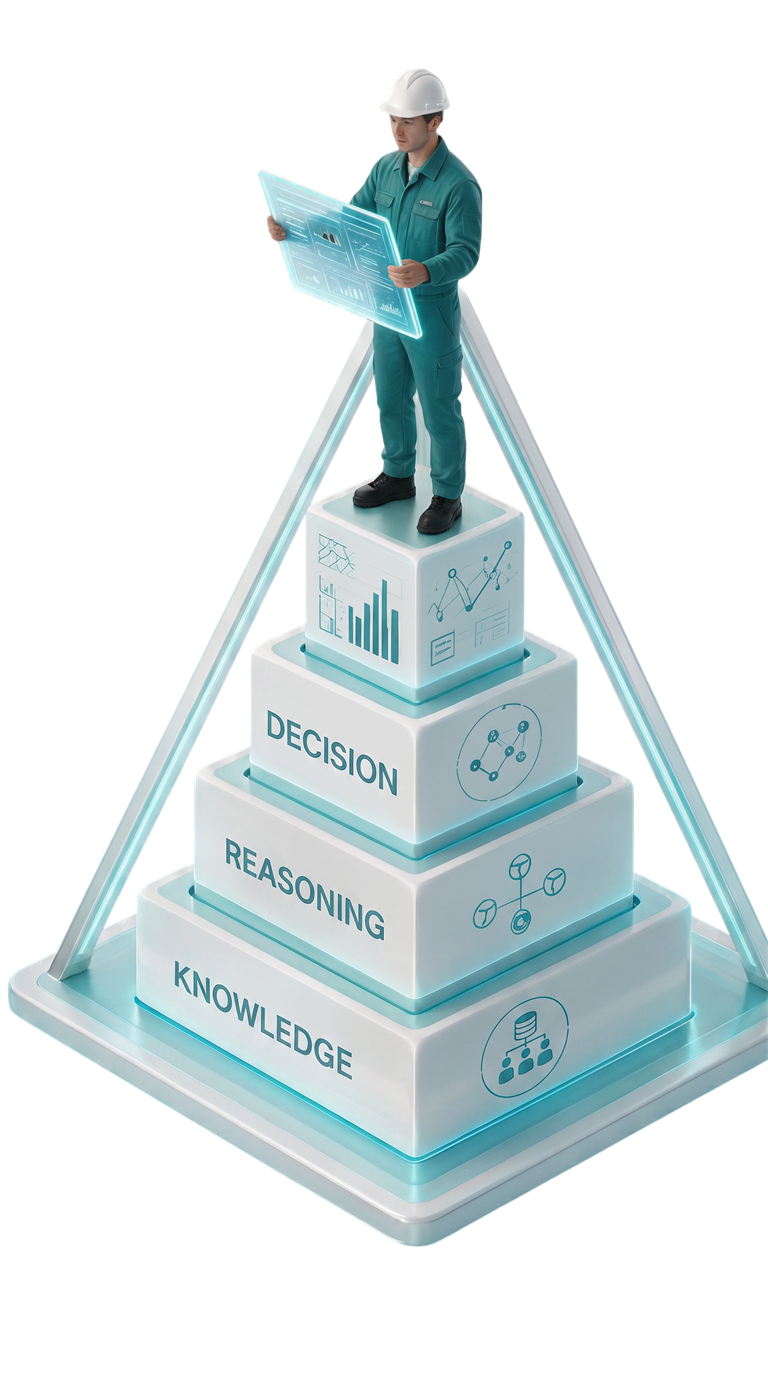
CHIMBUInteresting. Now, a lot of AI training is being done by large language modeling. Wrench does not follow this path. The reason Wrench team have decided to adopt a different strategy is because this allows for Wrench to be able to provide better definition of context. What I mean is Wrench has approached this from a knowledge graph context. So Wrench AI utilizes a knowledge graph connected to a large language model.
Now, the knowledge graph is the repository of all knowledge that is gained from the project — the context of the project, the standards that apply to it. So the knowledge graph approach also enables our AI to become effective much quicker than modeling a large language model. Large language modeling is driven around the AI’s accuracy percentages getting better over time with large volumes of information we provide to it. Whereas in contrast, Wrench AI utilizes a knowledge graph build approach. So a given project, very specific to that project — the set of documents, the schedule, the budget, all of that information can be directly populated to the knowledge graph — that is developed with the expertise that Wrench brings to that project, to that industry.
Now, Wrench has been delivering project management solutions for over 25 years now. And people like myself, I come from the industry, I’ve spent over 25 years delivering projects. So collectively, I think we have in Wrench over 200 years of project delivery experience, and it is this knowledge and capability of the project understanding that is built into the knowledge graph. So delivering context is about understanding how all that information relates to each other and how it will benefit the project.
Q5 — What happens to my project data when I use Wrench AI?
DIJOOh, that’s interesting. But tell me one thing — what happens to my project data when I use Wrench AI?
CHIMBUThat’s a very interesting question, and I think that’s one of the most asked questions that we come across. And I think it’s relevant as well, because technical information is bound by non-disclosures and a lot of our customers are developing new projects or new products where the intellectual property is key.
Wrench’s design of the AI architecture locks all that information from your project into the knowledge graph, and that knowledge graph sits within the implementation. So it’s in a private, secure cloud, number one — and the information that is being passed from your document, from your project data, all that is then coming to the knowledge graph, by the large language model converting that into the graph database. And that session gets wiped clean as well. So while we utilize a large language model to understand the natural language question and understand the documents written in natural language, all that translation is controlled within the environment where Wrench is implemented, and that ensures that your information is secure.
DIJOSo I’m safe.
CHIMBUAbsolutely.
Q6 — What’s the key difference between Wrench AI and generic AI?
DIJOWhat is the key difference between Wrench AI and the generic AI?
CHIMBUInteresting. When we talk about generic AI, generic AI is the large language models that are available to the market and have been trained on large volumes of publicly available information. These large language models also have capabilities of reading and understanding documents. So they have vision capabilities — they are multi-modal today, so they can open Word files, Excel files, PDF files. So the generic AI today is very capable. Where it falls short is the defined boundaries within which you need that AI to perform the reviews.
DIJOYou have any particular example to illustrate with?
CHIMBUWe spoke briefly about the bid analyzer agent that Wrench has developed. That analyzer should understand the RFQ — the request for quotation — frame, understand the standards, understand the particular project on which it is being implemented, and then evaluate all the offers that come in. So it needs to understand what the requirements are and, based on the context of the project, assess all the bids being received.
A generic AI — you could ask it to compare this RFQ with four bids and it would do it. It might not have the ability to understand: now, this could be a power plant project, this could be an oil and gas project. And if it’s a pipeline project, it would be governed by certain international standards. It would also have the requirement to understand whether the vendors are quoting all of what you’ve asked for, or they have provided some exceptions or deviations. Understanding those deviations and exceptions in the context of your project requires us to develop the guardrails. So Wrench’s bid analyzer, as an agent, is designed to understand your specific project. And that specificity is the framework around which it’s reviewing all of the tenders being submitted, all the quotations being submitted by the bidders.
And that’s where Wrench AI is significantly different. So if I were to summarize the differences: the first thing is the way the knowledge graph provides context. The next, more important thing, is how it’s able to maintain your information in the private, secure cloud. And because of these two working together in one environment, you could audit this. So with the ability of the client to explore and have a line of sight into the AI’s brain, you have the confidence that it has been structured correctly — it is not going to give you incorrect relationships, because you can see the relationships mapped within the Wrench AI, which is what is meaningful for your project.
Q7 — Does Wrench use a particular LLM?
DIJOYou mentioned about some LLM, right? So does Wrench use any LLM particularly?
CHIMBUIt’s a very good question. Now, Wrench has developed the structure of knowledge graph with an LLM together, providing the services of the AI, designing the different AI agents. We have used Microsoft Azure AI services. We have also connected to client-provided AI services, where the client may already have a subscription, or in some cases the clients have developed their own LLM capability.
Now, because Wrench AI is agnostic to which LLM we use, we’re able to connect it to a number of different options. Now, this capability of Wrench has also helped our customers who have on-premise implementations to still be able to use the LLM. So Wrench is able to implement the Wrench product along with our AI services in an on-premise environment, with a local large language model servicing the requirements of the LLM.
So — three different ways Wrench provides an LLM that is approved by the organization. So if there is a preference to use a particular large language model, Wrench could subscribe. Clients could provide access to their subscription to AI services or the large language models. We could utilize a local implementation of LLM. So these are the different flexibilities and strengths you get with the architecture Wrench.
Q8 — Which LLM is your favorite?
DIJOThat’s nice. Which one is your favorite?
CHIMBUThat’s also a very interesting question. See, we look at whether the large language model has the required reasoning abilities. So from that context, even when we go for the local implementations, we try and choose a model that has got the reasoning capability. So when we say it’s LLM agnostic, it doesn’t mean we can use “GPT Mini.” We have to use certain abilities for the AI to understand your question. So that reasoning capability is something we have to assess.
So when we say we are LLM agnostic, that doesn’t mean we just need the basic LLM. Our technology team would evaluate, assess, test — and we have the proven structure with which we would do the testing. And that’s how we identify which LLM would be needed for us to get our agents enabled — because the agents are utilizing the Wrench capabilities of doing commenting, receiving documents, transmitting documents.
So these agentic capabilities are all built within the product. The large language model’s role is to interpret the natural language — be it documents, be it the questions asked by the user — and also bring this multilingual capability, because the large language models of today are able to understand Spanish as well as English and as well as German. So it helps for us to have the large language model that understands the requirements of the project.
Q9 — Which deployment methodology is most recommended?
DIJOYeah. Which methodology is most recommended?
CHIMBUInterestingly, it really depends on the maturity of the customer, what’s already available. Customers who already have an on-premise implementation — the most recommended would be to do a local LLM. If the customer already has subscriptions to an AI, we could utilize that LLM. If a customer is just beginning the journey and there are no subscriptions or ongoing engagements with a service provider, Wrench would bring the complete package. So the quickest to deploy would be to obviously start with what Wrench can provide. That way you get from your beginning to an available service, which adds value when Wrench provides the complete package. And you could always swap out the large language models that are linked to the instance.
Q10 — Wouldn’t it be better to build this internally?
DIJOPeople will trust an AI only if it can recommend something which is very close to the real-life project experiences. Wouldn’t it be better if they build it internally?
CHIMBUAbsolutely. A lot of organizations are actually choosing that path. It’s not [just] in building the information, building the structure, building the context — it’s really identifying what use cases will be most meaningful. How would AI help with the productivity, compliance, and intelligence gathering?
Wrench is a tool that has already been gathering that capability and understanding across multiple industries, and it brings that collective understanding of meaningful AI productivity tools, drawing on the strength of the platform that already is aiming at improving collaboration and improving engagement on the project.
Building AI from scratch would certainly help, but it takes longer for organizations to realize the benefits of AI tools that would help the project team. Implementing Wrench, on the other hand, would be a quicker way to realize the productivity and the environment that is required for AI to grow further. So Wrench brings a platform that’s pre-built that allows for business to build further on.
OUTRO
DIJOThanks a lot, Chimbu, for giving us this valuable insights.
CHIMBUIt is my pleasure. So as a closing thought, where we’d like to leave you is on the key points we discussed today. So we discussed the relevance of context, how Knowledge Graph is able to address that scenario, how Wrench is able to provide a private, secure implementation and how your information stays secure in your vault.
We also talked about how large language model agnostic implementation, which means you can use different large language models to achieve the same agentic services that Wrench provides.
And I think the most relevant bit of discussion that we went through is how Wrench is able to bring the 25 years of project delivery experience and the functional knowledge of the people from the projects industry of over 200 years. That brings the difference to how Wrench AI is able to provide value to the engineering and EPC projects team.
Please feel free to reach out to us. We’ll be more than happy to provide you a demonstration of what we’ve built and clarify any queries you may have. Thank you.